Ancient Origin-
It may be reasonable to assume that piracy has existed for as long as the oceans were plied for commerce. The earliest documented instances of piracy are the exploits of the Sea Peoples who threatened the Aegean and Mediterranean in the 14th century BC. Inclassical antiquity, the Illyrians and Tyrrhenians were known as pirates, as well as Greeks and Romans. During their voyages the Phoenicians seem to have sometimes resorted to piracy, and specialized in kidnapping boys and girls to be sold as slaves.
In the 3rd century BC, pirate attacks on Olympos (city in Anatolia) brought impoverishment. Among some of the most famous ancient pirateering peoples were the Illyrians, populating the western Balkan peninsula. Constantly raiding the Adriatic Sea, the Illyrians caused many conflicts with the Roman Republic. It was not until 168 BC when the Romans finally conquered Illyria and made it a province that their threat was ended.
During the 1st century BC, there were pirate states along the Anatolian coast, threatening the commerce of the Roman Empire in the eastern Mediterranean. On one voyage across the Aegean Sea in 75 BC, Julius Caesar was kidnapped and briefly held by Cilician pirates and held prisoner in the Dodecanese islet of Pharmacusa.
The Senate finally invested with powers to deal with piracy in 67 BC (the Lex Gabinia), and Pompey after three months of naval warfare managed to suppress the threat.
Many pirates had roles in Chinese history since the Three Kingdoms period. An example includes Gan Ning of Eastern Wu.
As early as 258 AD, the Gothic-Herulic fleet ravaged towns on the coasts of the Black Sea and Sea of Marmara. The Aegean coast suffered similar attacks a few years later. In 264, the Goths reached Galatia and Cappadocia, and Gothic pirates landed on Cyprus and Crete. In the process, the Goths seized enormous booty and took thousands into captivity.
In 286 AD, Carausius, a Roman military commander of Gaulish origins, was appointed to command the Classis Britannica, and given the responsibility of eliminating Frankish and Saxon pirates who had been raiding the coasts of Armorica and Belgic Gaul.
In the Roman province of Britannia, Saint Patrick was captured and enslaved by Irish pirates.
Early Polynesian warriors attacked seaside and riverside villages. They used the sea for their hit-and-run tactics – a safe place to retreat to if the battle turned against them.

Caribbean-
In 1523, Jean Fleury seized two Spanish treasure ships carrying Aztec treasures from Mexico to Spain. The great or classic era of piracy in the Caribbean extends from around 1560 up until the mid-1720s. The period during which pirates were most successful was from 1700 until the 1730s. Many pirates came to the Caribbean after the end of the War of the Spanish Succession, staying in the Caribbean and becoming pirates. Others, the buccaneers, arrived in the mid-to-late 17th century and made attempts at earning a living by farming and hunting on Hispaniola and nearby islands; pressed by Spanish raids and possibly failure of their means of making a living (wild herds having been deliberately wiped out by the Spanish) they turned to a more lucrative occupation. Caribbean piracy arose out of, and on a smaller scale mirrored, the conflicts over trade and colonization among the rival European powers of the time including the empires of Britain, Spain, the Netherlands, Portugal and France. Most of these pirates were of English, Dutch and French origin, but occasionally Spaniards turned to piracy as well. Because Spain controlled most of the Caribbean, many of the attacked cities and ships belonged to the Spanish Empire and along the East coast of America and the West coast of Africa. Dutch ships captured about 500 Spanish and Portuguese ships between 1623 and 1638. Some of the best-known pirate bases were New Providence, in the Bahamas from 1715 to 1725, Tortuga established in the 1640s and Port Royal after 1655. Among the most famous Caribbean pirates are Edward Teach or Blackbeard, Calico Jack Rackham, Henry Morgan and Bartholomew Roberts.
Another famous pirate of this era was Hendrick Lucifer, who fought for hours to acquire Cuban gold, becoming mortally wounded in the process. He died of his wounds hours after having transferred the booty to his ship. Most pirates were eventually hunted down by the Royal Navy and killed or captured; several battles were fought between the brigands and the colonial powers on both land and sea.
Piracy in the Caribbean declined for the next several decades after 1730, but by the 1810s many pirates roamed American waters though they were not as bold or successful as their predecessors. Throughout the first quarter of the 19th century, the United States Navy repeatedly engaged pirates in the Caribbean, Gulf of Mexico and in the Mediterranean. Several warships were designed specifically for the task. The most successful pirates of the era were Jean Lafitte and Roberto Cofresi. Lafitte's ships operated primarily in the Gulf of Mexico but Cofresi's base was in Puerto Rico where he was considered a type of Robin Hood by many Puerto Ricans. Eventually he was defeated by the schooner USS Grampus and captured in 1825. The United States landed shore parties on several islands in the Caribbean in pursuit of pirates; Cuba was a major haven. By the 1830s piracy had died out again, and the navies of the region focused on the slave trade.
In 1827, Britain declared that participation in the slave trade was piracy, a crime punishable by death. The power of the Royal Navy was subsequently used to suppress the slave trade, and while some illegal trade (mostly with Brazil and Cuba) continued, the Atlantic slave trade was eradicated by the middle of the 19th century.
In the 20th century, one notable pirate active in the Caribbean was Boysie Singh. He operated off northern South America. He and his pirate gang killed several people and plundered their ships from 1947 to 1956. He was convicted for murder and hanged in the Royal Gaol at Trinidad, on 20 August 1957.
Recently, with the proliferation of small private yachts cruising the Caribbean, piracy is again on the rise with many yachts being plundered and their crews often tortured, raped or slain.
Asia-
By the ninth century, populations centered mostly around merchant activities in coastal Shandong and Jiangsu provinces. Wealthy benefactors, including Jang Bogo established Silla Buddhist temples in the region. Jang Bogo had become incensed at the treatment of his fellow countrymen, who in the unstable milieu of late Tang often fell victim to coastal pirates or inland bandits. After returning to Silla around 825, and in possession of a formidable private fleet headquartered at Cheonghae (Wando), Jang Bogo petitioned the Silla king Heungdeok (r. 826–836) to establish a permanent maritime garrison to protect Silla merchant activities in the Yellow Sea. Heungdeok agreed and in 828 formally established the Cheonghae Garrison at what is today Wando island off Korea's South Jeolla province. Heungdeok gave Jang an army of 10,000 men to establish and man the defensive works. The remnants of Cheonghae Garrison can still be seen on Jang islet just off Wando's southern coast. Jang's force, though nominally bequeathed by the Silla king, was effectively under his own control. Jang became arbiter of Yellow Sea commerce and navigation.
Piracy in South East Asia began with the retreating Mongol Yuan fleet after the betrayal by their Javanese allies (who, incidentally, would found the empire of Majapahit after the Mongols left). They preferred the junk, a ship using a more robust sail layout. Marooned navy officers, consisting mostly of Cantonese andHokkien tribesmen, set up their small gangs near river estuaries, mainly to protect themselves. They recruited locals as common foot-soldiers known as 'lang' (lanun) to set up their fortresses. They survived by utilizing their well trained pugilists, as well as marine and navigation skills, mostly along Sumatran and Javanese estuaries. Their strength and ferocity coincided with the impending trade growth of the maritime silk and spice routes.
During the mid-Qing dynasty, Chinese pirate fleets grew increasingly powerful throughout the early 19th century. The effects large-scale piracy had on the Chinese economy were immense. They preyed voraciously on China's junk trade, which flourished in Fujian and Guangdong and was a vital artery of Chinese commerce. Pirate fleets exercised hegemony over villages on the coast, collecting revenue by exacting tribute and running extortion rackets. In 1802, the menacing Zheng Yi inherited the fleet of his cousin, captain Zheng Qi, whose death provided Zheng Yi with considerably more influence in the world of piracy. Zheng Yi and his wife, Zheng Yi Sao (who would eventually inherit the leadership of his pirate confederacy) then formed a pirate coalition that, by 1804, consisted of over ten thousand men. Their military might alone was sufficient to combat the Qing navy. However, a combination of famine, Qing naval opposition, and internal rifts crippled piracy in China around the 1820s, and it has never again reached the same status.

Popular image-
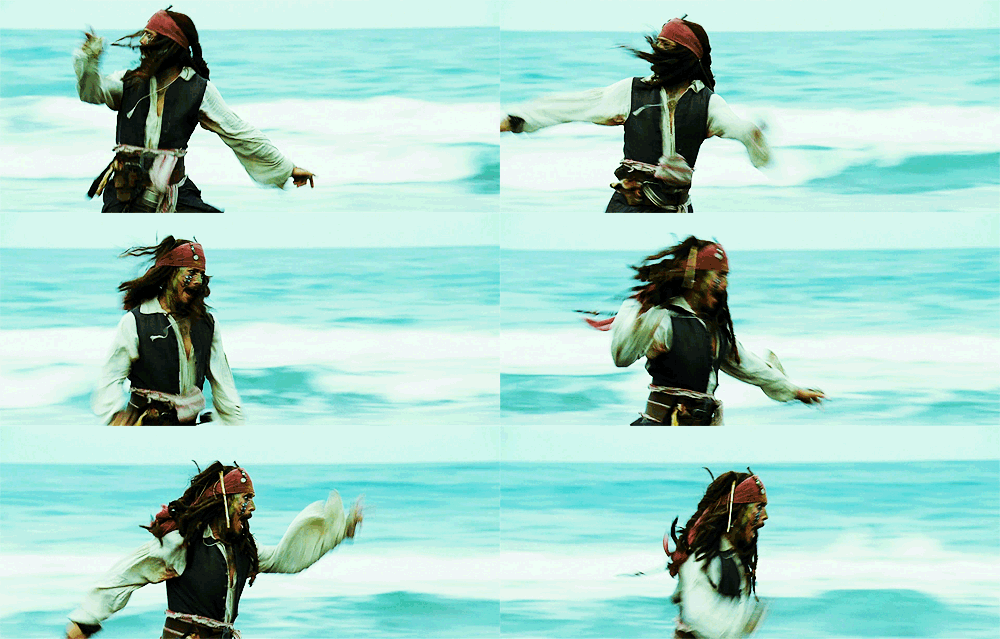
In the popular modern imagination, pirates of the classical period were rebellious, clever teams who operated outside the restricting bureaucracy of modern life. Pirates were also depicted as always raising their Jolly Roger flag when preparing to hijack a vessel. The Jolly Roger is the traditional name for the flags of European and American pirates and a symbol for piracy that has been adopted by film-makers and toy manufacturers.
Various claims and speculation about their overall image, attire, fashion, dress code, etc. have been made and contributed to their fanciful mystery and lore. Including, for example, men getting their ear pierced was popular with pirates; the value of the earring was meant to pay for their burial if they were lost at sea and their body washed ashore.
Unlike traditional Western societies of the time, many Caribbean pirate crews of European descent operated as limited democracies. Pirate communities were some of the first to instate a system of checks and balances similar to the one used by the present-day United States and many other countries. The first record of such a government aboard a pirate sloop dates to the 17th century.
Both the captain and the quartermaster were elected by the crew. They, in turn, appointed the ship's other officers. The captain of a pirate ship was often a fierce fighter in whom the men could place their trust, rather than a more traditional authority figure sanctioned by an elite. However, when not in battle, the quartermaster usually had the real authority. Many groups of pirates shared in whatever they seized. Pirates injured in battle thus might be afforded special compensation similar to medical or disability insurance.
There are contemporary records that many pirates placed a portion of any captured money into a central fund that was used to compensate the injuries sustained by the crew. Lists show standardised payments of 600 pieces of eight ($156,000 in modern currency) for the loss of a leg down to 100 pieces ($26,800) for loss of an eye. Often all of these terms were agreed upon and written down by the pirates, but these articles could also be used as incriminating proof that they were outlaws.
Treasure-
Even though pirates raided many ships, few, if any, buried their treasure. Often, the "treasure" that was stolen was food, water, alcohol, weapons, or clothing. Other things they stole were household items like bits of soap and gear like rope and anchors, or sometimes they would keep the ship they captured (either to sell off or keep because it was better than their ship). Such items were likely to be needed immediately, rather than saved for future trade. For this reason, there was no reason for the pirates to bury these goods. Pirates tended to kill few people aboard the ships they captured; usually they would kill no one if the ship surrendered because, if it became known that pirates took no prisoners, their victims would fight to the last breath and make victory both very difficult and costly in lives. In contrast, ships would quickly surrender if they knew they would be spared. In one well-documented case 300 heavily armed soldiers on a ship attacked by Thomas Tew surrendered after a brief battle with none of Tew's 40-man crew being injured.
Other noteworthy speculation involving pirates and their perceived high-importance and priorities toward that of fortune-hunting and traditional treasure exist; such as the iconic image of pirates with ear piercing, was as a result of being a practical purpose among and therefore popular with pirates. The belief being the value of the earring was meant to pay for their burial if they were lost at sea and their body washed ashore.
Rewards-
Pirates had a system of hierarchy on board their ships determining how captured money was distributed. However, pirates were more "egalitarian" than any other area of employment at the time. In fact pirate quartermasters were a counterbalance to the captain and had the power to veto his orders. The majority of plunder was in the form of cargo and ship's equipment with medicines the most highly prized. A vessel's doctor's chest would be worth anywhere from £300 to £400, or around $470,000 in today's values. Jewels were common plunder but not popular as they were hard to sell, and pirates, unlike the public of today, had little concept of their value. There is one case recorded where a pirate was given a large diamond worth a great deal more than the value of the handful of small diamonds given his crewmates as a share. He felt cheated and had it broken up to match what they received. Spanish pieces of eight minted in Mexico or Seville were the standard trade currency in the American colonies. However, every colony still used the monetary units of pounds, shillings and pence for bookkeeping while Spanish, German, French and Portuguese money were all standard mediums of exchange as British law prohibited the export of British silver coinage. Until the exchange rates were standardised in the late 18th century each colony legislated its own different exchange rates. In England, 1 piece of eight was worth 4s 3d while it was worth 8s in New York, 7s 6d in Pennsylvania and 6s 8d in Virginia. One 18th-century English shilling was worth around $58 in modern currency so a piece of eight could be worth anywhere from $246 to $465. As such, the value of pirate plunder could vary considerably depending on who recorded it and where.
Ordinary seamen received a part of the plunder at the captain's discretion but usually a single share. On average, a pirate could expect the equivalent of a year's wages as his share from each ship captured while the crew of the most successful pirates would often each receive a share valued at around £1,000 ($1.17 million) at least once in their career. One of the larger amounts taken from a single ship was that by captain Thomas Tew from an Indian merchantman in 1692. Each ordinary seaman on his ship received a share worth £3,000 ($3.5 million) with officers receiving proportionally larger amounts as per the agreed shares with Tew himself receiving 2½ shares. It is known there were actions with multiple ships captured where a single share was worth almost double this.
By contrast, an ordinary seamen in the Royal Navy received 19s per month to be paid in a lump sum at the end of a tour of duty which was around half the rate paid in the Merchant Navy. However, corrupt officers would often "tax" their crews' wage to supplement their own and the Royal Navy of the day was infamous for its reluctance to pay. From this wage, 6d per month was deducted for the maintenance of Greenwich Hospital with similar amounts deducted for the Chatham Chest, the chaplain and surgeon. Six months' pay was withheld to discourage desertion. That this was insufficient incentive is revealed in a report on proposed changes to the RN Admiral Nelson wrote in 1803; he noted that since 1793 more than 42,000 sailors had deserted. Roughly half of all RN crews were press ganged and these not only received lower wages than volunteers but were shackled while the vessel was docked and were never permitted to go ashore until released from service.
Although the Royal Navy suffered from many morale issues, it answered the question of prize money via the 'Cruizers and Convoys' Act of 1708 which handed over the share previously gained by the Crown to the captors of the ship. Technically it was still possible for the Crown to get the money or a portion of it but this rarely happened. The process of condemnation of a captured vessel and its cargo and men was given to the High Court of the Admiralty and this was the process which remained in force with minor changes throughout the Revolutionary and Napoleonic Wars.
Even the flag officer's share was not quite straightforward; he would only get the full one-eighth if he had no junior flag officer beneath him. If this was the case then he would get a third share. If he had more than one then he would take one half while the rest was shared out equally.
There was a great deal of money to be made in this way. The record breaker, admittedly before our wars, was the capture of the Spanish frigate the Hermione, which was carrying treasure in 1762. The value of this was so great that each individual seaman netted £485 ($1.4 million in 2008 dollars). The two captains responsible, Evans and Pownall, got just on £65,000 each ($188.4 million). In January 1807 the frigate Caroline took the Spanish San Rafael which brought in £52,000 for her captain, Peter Rainier (who had been only a Midshipman some thirteen months before). All through the wars there are examples of this kind of luck falling on captains. Another famous 'capture' was that of the Spanish frigates Thetis and Santa Brigada which were loaded with gold specie. They were taken by four British frigates who shared the money, each captain receiving £40,730. Each lieutenant got £5,091, the Warrant Officer group, £2,468, the midshipmen £791 and the individual seamen £182.
It should also be noted that it was usually only the frigates which took prizes; the ships of the line were far too ponderous to be able to chase and capture the smaller ships which generally carried treasure. Nelson always bemoaned that he had done badly out of prize money and even as a flag officer received little. This was not that he had a bad command of captains but rather that British mastery of the seas was so complete that few enemy ships dared to sail.
Punishment-
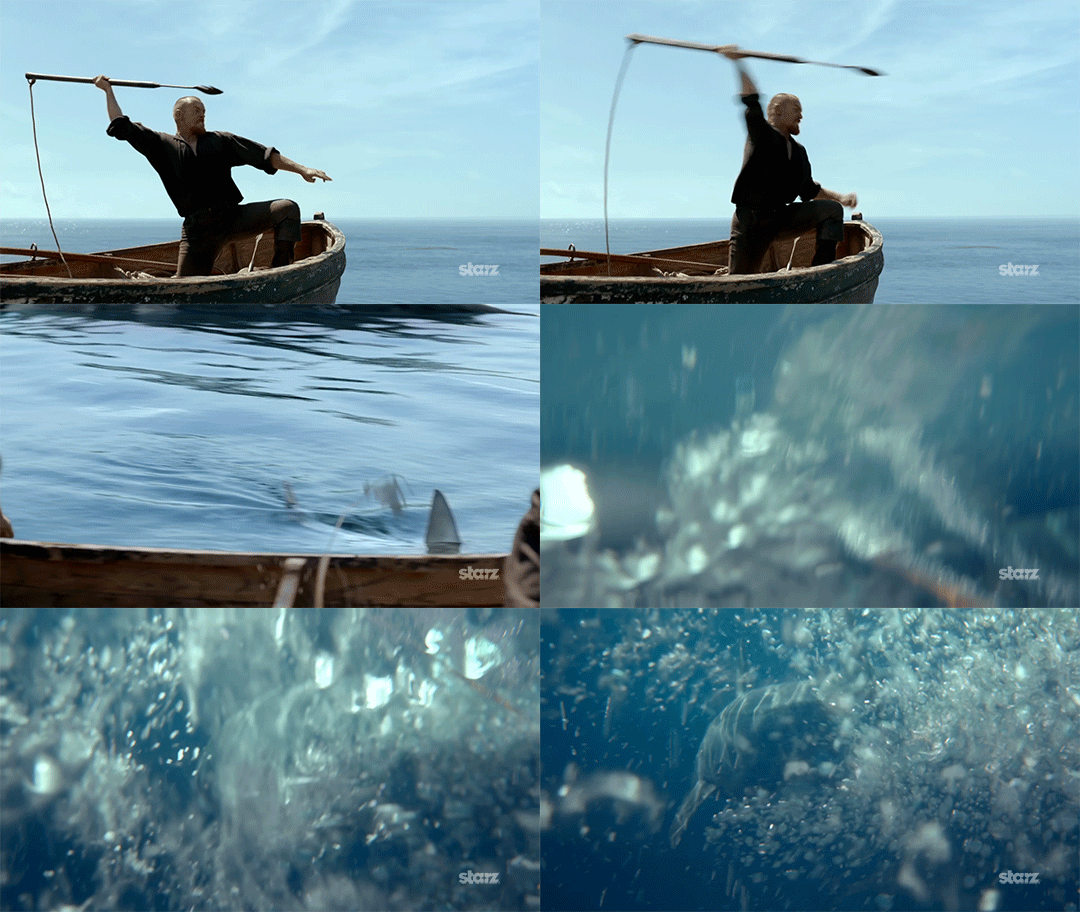
During the 17th and 18th centuries, once pirates were caught, justice was meted out in a summary fashion, and many ended their lives by "dancing the hempen jig", or hanging at the end of a rope. Public execution was a form of entertainment at the time, and people came out to watch them as they would to a sporting event today. Newspapers were glad to report every detail, such as recording the condemned men's last words, the prayers said by the priests for their immortal souls, and their final agonising moments on the gallows. In England most of these executions took place at Execution Dock on the River Thames in London.
In the cases of more famous prisoners, usually captains, their punishments extended beyond death. Their bodies were enclosed in iron cages (gibbet) (for which they were measured before their execution) and left to swing in the air until the flesh rotted off them- a process that could take as long as two years. The bodies of captains such as William "Captain" Kidd, Charles Vane, William Fly, and Jack Rackham ("Calico Jack") were all treated this way.
Within the Pirate community, however, 'Justice' was swift and decisive. 'Cut-throat prudence demanded nothing less. Famously, keelhauling was a popular method for relatively minor crimes, while 'abandonment' on an island was not unknown either. Indeed, 'Walking the plank' is now generally thought to refer to 'walking the last mile' down the gangplank to the miscreants new 'Home'.
Modern Age-
Seaborne piracy against transport vessels remains a significant issue (with estimated worldwide losses of US$13 to $16 billion per year), particularly in the waters between the Red Sea and Indian Ocean, off the Somali coast, and also in the Strait of Malacca and Singapore, which are used by over 50,000 commercial ships a year. In the late 2000s, the emergence of piracy off the coast of Somalia spurred a multi-national effort led by the United States to patrol the waters near the Horn of Africa. In 2011, Brazil also created an anti-piracy unit on the Amazon river.
In recent years, shipping companies claimed that their vessels suffer from regular pirate attacks on the Serbian and Romanian stretches of the international Danube river, i.e. inside the European Union's territory, starting from at least 2011.
Modern pirates favor small boats and taking advantage of the small number of crew members on modern cargo vessels. They also use large vessels to supply the smaller attack/boarding vessels. Modern pirates can be successful because a large amount of international commerce occurs via shipping. Major shipping routes take cargo ships through narrow bodies of water such as the Gulf of Aden and the Strait of Malacca making them vulnerable to be overtaken and boarded by small motorboats. Other active areas include the South China Sea and the Niger Delta. As usage increases, many of these ships have to lower cruising speeds to allow for navigation and traffic control, making them prime targets for piracy.
Also, pirates often operate in regions of developing or struggling countries with smaller navies and large trade routes. Pirates sometimes evade capture by sailing into waters controlled by their pursuer's enemies. With the end of the Cold War, navies have decreased size and patrol, and trade has increased, making organized piracy far easier. Modern pirates are sometimes linked with organized-crime syndicates, but often are parts of small individual groups.
The International Maritime Bureau (IMB) maintains statistics regarding pirate attacks dating back to 1995. Their records indicate hostage-taking overwhelmingly dominates the types of violence against seafarers. For example in 2006, there were 239 attacks, 77 crew members were kidnapped and 188 taken hostage but only 15 of the pirate attacks resulted in murder. In 2007 the attacks rose by 10% to 263 attacks. There was a 35% increase on reported attacks involving guns. Crew members that were injured numbered 64 compared to just 17 in 2006. That number does not include instances of hostage taking and kidnapping where the victims were not injured.
The number of attacks from January to September 2009 had surpassed the previous year's total due to the increased pirate attacks in the Gulf of Aden and off Somalia. Between January and September the number of attacks rose to 306 from 293. The pirates boarded the vessels in 114 cases and hijacked 34 of them so far in 2009. Gun use in pirate attacks has gone up to 176 cases from 76 last year.
The attack against the German built cruise ship the Seabourn Spirit offshore of Somalia in November 2005 is an example of the sophisticated pirates mariners face. The pirates carried out their attack more than 100 miles (160 km) offshore with speedboats launched from a larger mother ship. The attackers were armed with automatic firearms and an RPG.
Since 2008, Somali pirates centered in the Gulf of Aden made about $120 million annually, reportedly costing the shipping industry between $900 million and $3.3 billion per year. By September 2012, the heyday of piracy in the Indian Ocean was reportedly over. Backers were now reportedly reluctant to finance pirate expeditions due to the low rate of success, and pirates were no longer able to reimburse their creditors. According to the International Maritime Bureau, pirate attacks had by October 2012 dropped to a six-year low. Only five ships were captured by the end of the year, representing a decrease from 25 in 2011 and 27 in 2010, with only 1 ship attacked in the third quarter compared to 36 during the same period in 2011. However, pirate incidents off on the West African seaboard increased to 34 from 30 the previous year, and attacks off the coast of Indonesia rose from 2011's total of 46 to 51.
Many nations forbid ships to enter their territorial waters or ports if the crew of the ships are armed, in an effort to restrict possible piracy.